Strong earnings, higher hurdles: Can they continue to deliver?
Strong earnings, higher hurdles: Can they continue to deliver?
Earnings have provided a ballast
Despite geopolitical tensions, higher energy prices and the related prospect of interest rates remaining higher for longer, equity markets have been relatively resilient. One important reason has been corporate earnings.
Companies have continued to deliver strong sales and profit growth, while margins remain close to historic highs across several major regions. This has provided a solid foundation for markets, even as the economic and geopolitical backdrop has become more uncertain.
Sales and profits continue to expand at a rapid pace
Historic and consensus forecast S&P 500 sales and earnings growth (YoY %)

Source: Netwealth, Bloomberg as of August 2026.
The rapid expansion of artificial intelligence (AI) has been central to this strength. A small group of US “hyperscalers”, large technology companies that operate cloud infrastructure on an enormous scale, are investing heavily in the data centres, semiconductors and networks needed to support AI. Their combined investment could approach $850 billion in 2026.
Demand remains exceptional. Cloud providers continue to report that customer demand exceeds available capacity, while orders for AI-related services are growing rapidly. The benefits are also spreading beyond the largest US technology companies to semiconductor and memory producers, power-equipment suppliers, utilities, construction companies and data-centre supply chains around the world.
Higher investment, higher expectations
The scale of the AI buildout is changing the financial profile of the companies funding it. Many of the leading technology businesses became dominant by combining rapid growth, high margins and relatively modest investment needs. They are now becoming much more capital intensive. A growing share of the cash generated by their existing businesses is being directed towards infrastructure, leaving less immediately available for dividends and share buybacks.
Hyperscaler AI spending weighs on cash generation

Source: Netwealth, Bloomberg as of August 2026.
For several hyperscalers, planned investment is rising faster than operating cash flow, pushing free cash flow towards zero or into negative territory. If expenditure continues to grow faster than cash generated, some companies may eventually need to rely more heavily on borrowing or other sources of finance.
This is not necessarily a sign of financial stress. These remain highly profitable companies with strong balance sheets. However, investors are being asked to accept lower cash generation today in anticipation of greater revenues and profits tomorrow. The path is unlikely to be smooth, with demand, technology and infrastructure costs all evolving rapidly.
Comparisons with historic analogues such as the railway expansion era in the 19th century and the telecom infrastructure boom of the late 1990s are imperfect. Today’s hyperscalers are profitable, well financed and responding to substantial existing demand. Nevertheless, the central lesson still applies: a new technology can transform lives and economies without every company financing its expansion earning an attractive return.
Q2 earnings clear a high bar
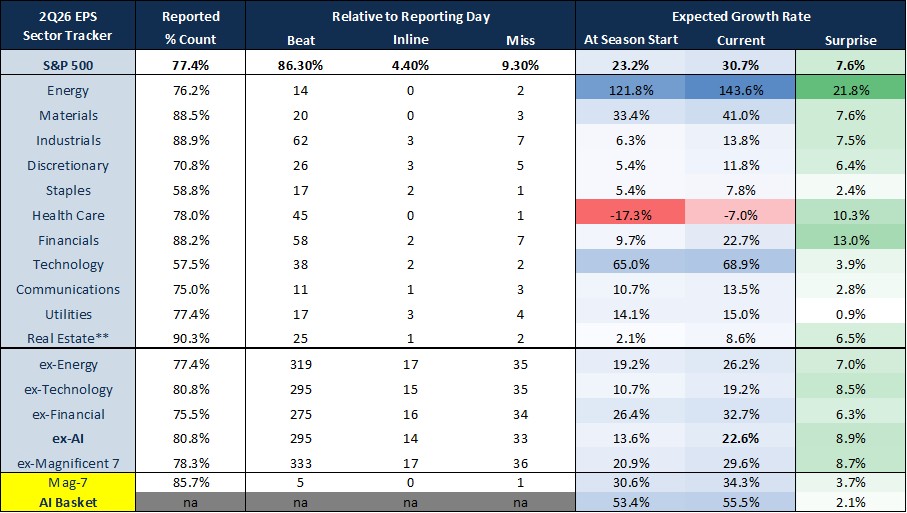
The second-quarter US earnings season arrived at a sensitive point for the market, with investors challenging the sustainability of the AI tailwind. Also, companies entered the reporting season expected to deliver 23.2% year-on-year earnings growth, already an unusually strong rate more commonly associated with a recovery from a downturn. There was therefore little room for disappointment.
With around 75% of the key S&P 500 Index having reported, the season has so far cleared that high bar. Profits growth is now on course to finish above 30%, while forecasts for future quarters have continued to rise. However, the most useful insights lie beneath the impressive headline numbers.
Hyperscalers face the monetisation test
While the major hyperscalers broadly exceeded cloud revenue expectations, they also announced further increases in capital expenditure. As a result, the market’s differentiation between hyperscalers came down to a key question:
Is investment producing visible, accelerating revenue, and is there a credible path towards recovering free cash flow?
Investors are not uniformly opposed to high investment when higher revenues follow. Microsoft and Amazon were rewarded because accelerating cloud growth provided a clearer connection between spending and demand. Both also reported substantial customer order books, while Microsoft showed that monetisation is extending beyond infrastructure through paid products such as Copilot. Microsoft’s investment is also relatively flexible, with much of its spending directed towards shorter-lived equipment that can be adjusted more quickly if demand changes. Amazon provided further reassurance by explaining that much of its AI capacity is contracted for at least five-year terms and that servers should recover their cost well within those contracts.
Alphabet and Meta offered less visibility. Alphabet delivered strong cloud growth, but higher investment pushed quarterly free cash flow below zero and management did not convincingly articulate when cash generation might begin to recover. Meta's position was also less clear. Much of its AI spending is intended to improve advertising, engagement and its own products rather than generate directly identifiable cloud revenue. These benefits may prove valuable, but they are harder to measure against the amount being invested.
Strong results extend beyond AI
The strength of the season extends well beyond hyperscalers and the AI supply chain. Around 86% of reporting S&P 500 companies have exceeded earnings expectations, well above historical averages. Strong revenues suggest that results reflect healthy demand rather than cost reductions alone. All sectors have delivered earnings which have surprised positively, with many recording double-digit annual profit growth, representing a marked shift in dynamics.
Earnings momentum is broadening
2Q 2026 S&P 500 Earnings sector tracker
Source: Netwealth, Bloomberg as of August 2026.
Only a few quarters ago, almost all the index’s profit growth came from the “Magnificent Seven”. The rest of the market is now contributing more meaningfully, making the earnings picture less dependent on a handful of technology companies.
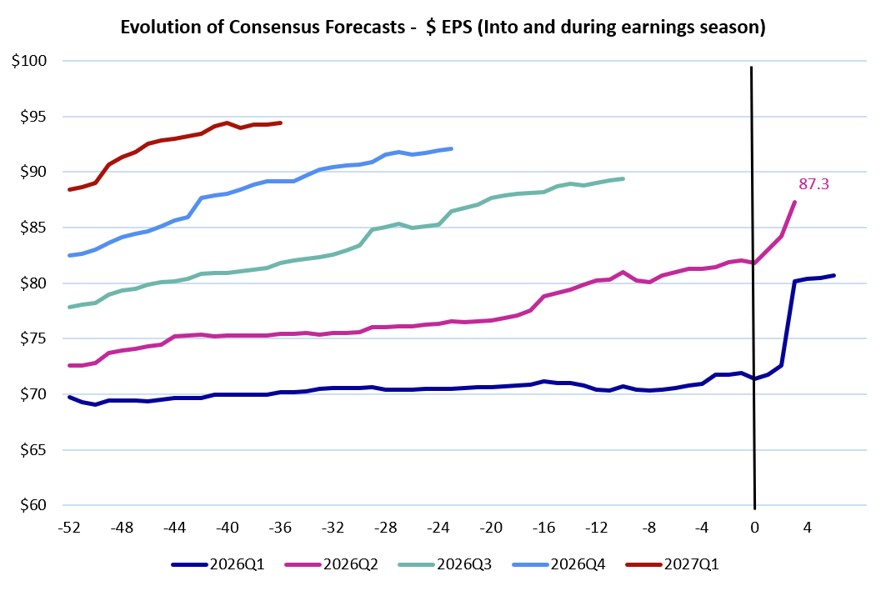
Despite already demanding expectations, analysts have continued to raise future forecasts. Normally, estimates tend to be revised lower as a reporting season progresses. Their continued rise suggests that strong results have been accompanied by confidence from company management teams about the outlook.
The bar is still rising
Consensus quarterly $ earnings forecasts in the 1-year run-up to and through earnings season
Source: Netwealth, Bloomberg as of August 2026.
The broader picture
Stepping back from the quarterly results, the broader corporate fundamental picture across regions remains healthy. Sales and earnings are growing above trend, margins remain historically strong and analysts continue to raise forecasts. Although AI investment has been an important driver, the strength in corporate activity is becoming more broadly based across sectors and regions, speaking to more genuine activity uplift.
However, strong profits do not tell the whole story. As alluded to above in this article, companies in some markets are converting a smaller proportion of their reported profits into cash as investment rises. In the US, companies are converting around 71% of net income into free cash flow, close to the lower end of the historical range in our data. Capital investment is accounting for an elevated % of sales and is running at more than twice the annual depreciation of existing assets.
This does not necessarily mean that the earnings are less reliable. Much of the difference reflects deliberate investment in future growth. It does mean, however, that a smaller share of today’s profits is immediately available to shareholders.
Dividend payout ratios and share buybacks have fallen as companies retain more cash to finance expansion. Some are also borrowing or issuing new shares. The corporate picture is therefore best described as highly profitable, but increasingly investment intensive.
Reassuringly, this investment cycle began from a position of financial strength. The major hyperscalers continue to generate substantial cash from their existing businesses, while borrowing across the wider US corporate sector remains low relative to history. Balance sheets in Japan and several technology-heavy emerging markets are also in historically strong positions. The principal risk is therefore not widespread financial distress, but that future returns fail to justify the investment being made.
Why this matters for investors
The earnings backdrop remains supportive. Growth in profits is strong, margins remain elevated and the participation is broadening across sectors and regions. The latest reporting season has also reduced the immediate concern that AI investment is running ahead of demand.
Revenue growth is only the first test. As investment rises, companies must demonstrate that they can ultimately produce stronger earnings, cash flow and returns on capital.
For investors, the main conclusions are:
-
The broader earnings backdrop remains supportive, with strong earnings momentum, profitability and improving forecasts.
-
AI demand is real, but earnings and cashflow need to be demonstrated.
-
The opportunity extends beyond US technology, with beneficiaries across sectors and regions.
-
Diversification remains important, because the rewards from AI will not be shared evenly.
The balance of evidence remains encouraging. Earnings continue to provide an anchor for markets, and the signs of AI monetisation are becoming clearer. But the hurdle is rising and ultimately strong demand must increasingly be matched by strong financial returns.
If you want to find out more about our investment approach, and how we can help you to achieve your goals, please get in touch: https://www.netwealth.com/contact-us/.
Please note: This article is provided for informational purposes only and does not constitute investment advice, a personal recommendation, or an offer to buy or sell any investment. The value of investments can fall as well as rise and investors may get back less than they originally invested.